

 United Kingdom
 China
 Hong Kong SAR
 India
 Indonesia
 Japan
 Malaysia
 Middle East
 Taiwan
 Thailand
 Turkey

Freehold vs Leasehold – Which is right for Singapore buyers of London property?
- Advice clinic
- 23.07.24
- Benham and Reeves
Buying property in London from Singapore comes with a few important differences compared with buying a home locally. One of the first things you’ll come across when looking at London property is property tenure, in simple terms, whether you’re buying freehold, leasehold, or a share of freehold.
For Singapore buyers, understanding this landscape early is essential: for new and existing residential developments, most London apartments are leasehold, while houses are more commonly freehold. In fact, London has the highest proportion of leasehold homes of any region in England, with around 39% of its housing stock being leasehold in 2024–25.
So, if you’re considering a London apartment, choosing a leasehold property isn’t necessarily a compromise. Rather than ruling out leasehold altogether, overseas investors should look closely at the lease length, service charges, any planned major works and the property’s long-term resale potential.
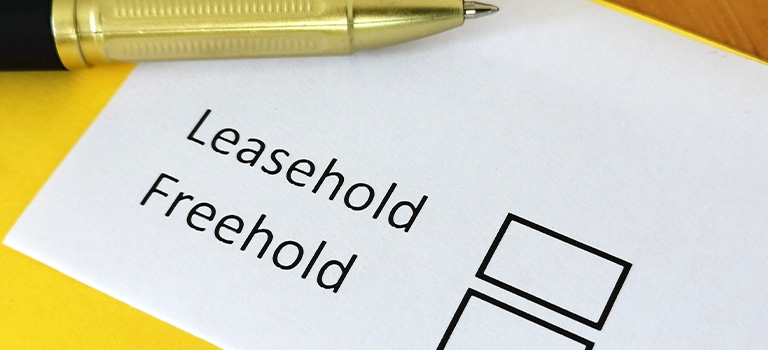
Freehold vs leasehold vs share of freehold: what’s the difference?
| Tenure | What you own | Key investor consideration |
|---|---|---|
| Leasehold | The right to own and occupy the property for the length of the lease | Lease length, service charges, and ground rent can affect costs, mortgageability, and resale |
| Share of freehold | Your individual leasehold property plus a share of the building’s freehold | More influence over building management and lease terms, but responsibilities are shared |
| Freehold | The property and the land it stands on, indefinitely | Greater control with no lease expiry or ground rent |
Freehold

With a freehold property, you own both the property and the land it sits on. There’s no lease to run out, but you’ll usually be responsible for looking after the property, including its maintenance, insurance and other related costs.
Freehold houses can therefore offer greater control and long-term security. However, these standalone or terraced residential houses are often more expensive than typical leasehold properties, such as modern high-rise apartments or conversion flats, particularly in sought-after areas of London.
Leasehold

With a leasehold property, you own the right to occupy the property for a fixed period under the terms of the lease, while the freeholder owns the building or land.
Leasehold is the standard form of ownership for flats in England. Lease terms can vary considerably, but many modern London developments offer extremely long leases, often 999 years. Current London developments continue to offer 999-year leases, including new-build schemes in areas such as Cockfosters, Waterloo and Poplar.
A 999-year lease should therefore be viewed very differently from an older flat with, for example, 70 or 80 years remaining.
Share of freehold
A share of freehold gives you your leasehold interest in the individual flat while also giving you a stake in the freehold of the building.
This can give owners greater involvement in how the building is managed and can make future lease management more straightforward. However, owning a share of freehold does not mean your flat automatically stops being leasehold. Your individual property will normally still have a lease.
Some new developments offer this structure. For example, Angel Village in Islington is currently marketed as a 999-year leasehold development with a share of freehold.
Why are most London apartments leasehold?
Leasehold is particularly common for apartments because a building may contain dozens or hundreds of individual homes alongside shared areas such as entrances, lifts, gardens, gyms and other facilities.
A lease provides the legal framework for each individual apartment while allowing the building and its communal areas to be managed collectively.
For a Singapore buyer looking at a London apartment, therefore, seeing “leasehold” on the property details should not immediately be a red flag. The length and terms of the lease matter far more than the word leasehold alone.
How long are leaseholds on London apartments usually?
Lease terms vary by development, but among new-build apartments in London, 999-year leases are commonly offered by developers. Resale properties can have widely varying remaining lease terms, so buyers should check the individual lease carefully.
For most qualifying new residential leases granted on or after 30 June 2022, ground rent is restricted to a peppercorn, effectively zero.
This means that a Singapore buyer purchasing a newly built London apartment may have little practical concern about the lease running down during their ownership.
However, the lease should still be reviewed carefully. A long lease does not automatically mean low running costs. Service charges, building insurance, reserve funds and potential major works can have a much greater impact on the economics of an apartment investment.
What should Singapore investors check before buying a leasehold London property?
For most qualifying new residential leases granted on or after 30 June 2022, ground rent is restricted to a peppercorn, effectively zero. Buyers of resale properties should still check any existing ground rent and review clauses, alongside the remaining lease term, service charges, planned major works and resale considerations.
1. Remaining lease term
New-Builds (Typically 125 to 999 Years): A long lease gives buyers greater peace of mind, with little concern about the lease becoming a problem over time.
Resale Properties (Variable Terms, e.g., <80 Years): Resale leases vary widely. Under the current statutory rules for flat lease extensions, marriage value can increase the extension premium where the lease has 80 years or fewer remaining when the formal lease-extension notice is served. Shorter leases can also make it harder to secure a mortgage, as some lenders have stricter lending criteria for properties with limited lease terms.
2. What are the service charges?
For apartment homeowners, service charges represent one of the most significant ongoing operational costs to consider.
Service charges can cover things such as:
These costs vary significantly between buildings. A development with extensive amenities may have higher annual service charges than a simpler apartment building.
Before purchasing, request the current service charge for resale properties or the estimated service charge budget for new-builds, as actual costs for new developments may increase once completed and operational.
3. Are there any major structural works planned?
A low service charge might look like a saving, but it doesn’t always mean you’re actually spending less.
If a building needs significant repairs down the line, like a full roof replacement or a new lift, leaseholders are the ones who contribute towards the cost. Most well-managed properties collect reserve (or sinking) funds over time to help fund future repairs and reduce the impact of unexpected costs, but not all of them do.
If you’re investing from abroad, checking the building’s long-term maintenance schedule is crucial.
4. Could the tenure affect resale?
Yes, it can. A property with a longer lease is generally easier to sell than one with only a short period left on the lease.
If you’re buying in London from Singapore, it’s worth looking beyond the price tag. The remaining lease, service charges and condition of the development can all influence how appealing the property is to future buyers.
A well-located apartment with a long lease and reasonable service charges can still be an attractive option, even though it is leasehold.
What does the Leasehold and Freehold Reform Act 2024 mean for London buyers?
The Leasehold and Freehold Reform Act 2024 is part of the government’s wider effort to reform the leasehold system in England and Wales.
While the Leasehold and Freehold Reform Act 2024 is now law, its provisions are being implemented in stages. Certain reforms are already live; such as the removal of the two-year ownership requirement on 31 January 2025, allowing leaseholders to claim an extension immediately upon purchase. However, other major provisions, including 990-year statutory extensions and changes to valuation rules and the abolition of marriage value, remain subject to secondary legislation and consultation before coming into full effect.
For Singapore buyers, the takeaway is simple: don’t make a purchase based on reforms that aren’t in force yet. Instead, look at the lease and the costs attached to the property as they stand today.
Which tenure suits your London property plans?
Freehold offers permanent ownership and greater control, which can be particularly attractive when buying a house. However, leasehold remains the primary ownership model for London apartments.
For Singapore buyers, the key is to assess whether the property’s tenure, ownership costs and management arrangements suit their intended use, budget and ownership horizon.
A 999-year lease with reasonable service charges, good building management and strong resale appeal can be a perfectly sensible investment. Conversely, an older leasehold property with a short remaining term, high service charges and significant upcoming works may require much more careful consideration.
Speak directly with our local Singapore team for expert guidance on navigating property tenures, yields, and opportunities.
Book an Appointment with Our Singapore Office
FAQs
What is the difference between freehold and leasehold property?
Freehold means you own the property and the land indefinitely. Leasehold means you own the right to occupy the property for a fixed period under a lease. Most flats in England are leasehold, while houses are more commonly freehold.
Is freehold better than leasehold?
Freehold offers permanent ownership and greater control, but leasehold is the standard tenure for most London apartments. For an investor, the remaining lease term, service charges, major works and resale prospects can be more important than whether the property is simply labelled freehold or leasehold.
Are London apartments leasehold?
Yes. Leasehold is still the more common way of owning a flat in England, particularly in London. In fact, around 39% of London’s housing stock was leasehold in 2024–25, giving the capital one of the highest shares of leasehold homes in the country.
What is the share of the freehold?
Share of freehold means you own your individual flat on a leasehold basis while also owning a share of the freehold of the wider building. It can provide greater involvement in how the building is managed, but the individual flat will generally still have a lease.
Do new London properties have ground rent?
For most qualifying new residential leases granted on or after 30 June 2022, ground rent is restricted to a peppercorn, effectively zero. That said, it’s still worth checking the individual lease for any exceptions.
Does lease length affect a London property’s value?
Yes. Generally, a longer lease is more valuable than an otherwise comparable property with a shorter lease. Once a lease becomes relatively short, particularly below 80 years, it can become harder to sell or mortgage and may require a costly extension.
What should Singapore buyers check before buying a leasehold property in London?
At a minimum, check the remaining lease term, service charge, reserve or sinking fund, planned major works, building insurance arrangements and any restrictions contained in the lease. It is also important to obtain independent legal and financial advice before committing to a purchase.

About the Author
Benham & Reeves has been shaping London’s prime property market since 1958. In 1999, we launched one of the very first London‑focused estate agency offices in Singapore to cater to growing investor demand. We were among the first dedicated London‑focused branches outside the UK. Our dedicated Singapore office is in Raffles Hotel — from here, the experienced, multilingual agents work seamlessly to assist a discerning clientele with buying, selling and letting London properties. We further offer end-to-end support, sourcing, acquisition, lettings, furnishing and complete property management – all on Singapore time.View all posts by Benham and Reeves